What to Use for Fastening Foam Insulation to Studs
Rigid Cream Insulation for Existing Exterior Walls
Telescopic
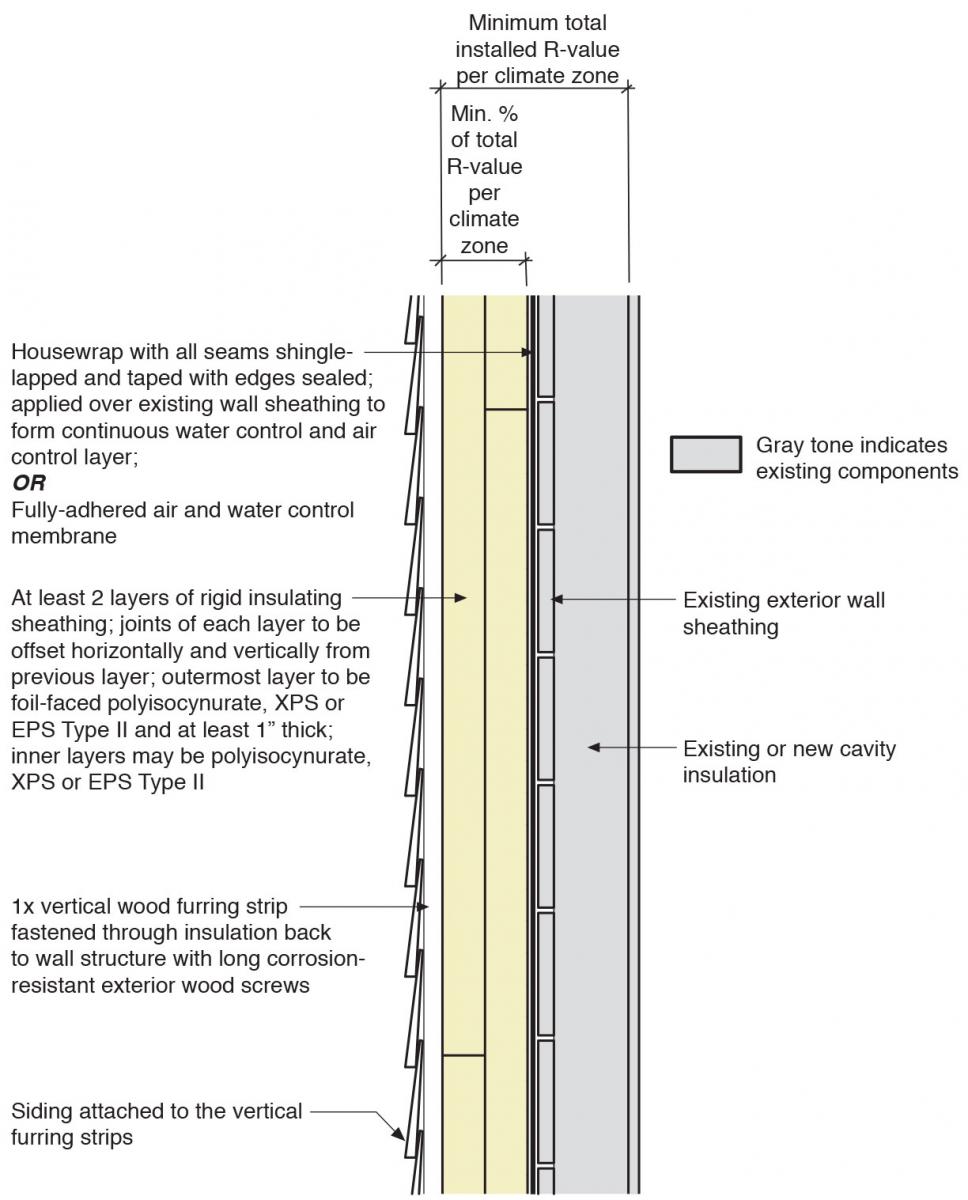
In this retrofit wall assembly, the air control layer is applied straight over the existing wall sheathing and then covered past at least 2 layers of insulating sheathing held in place by vertical furring strips. The vertical furring strips also provide the means of attachment for the exterior siding.
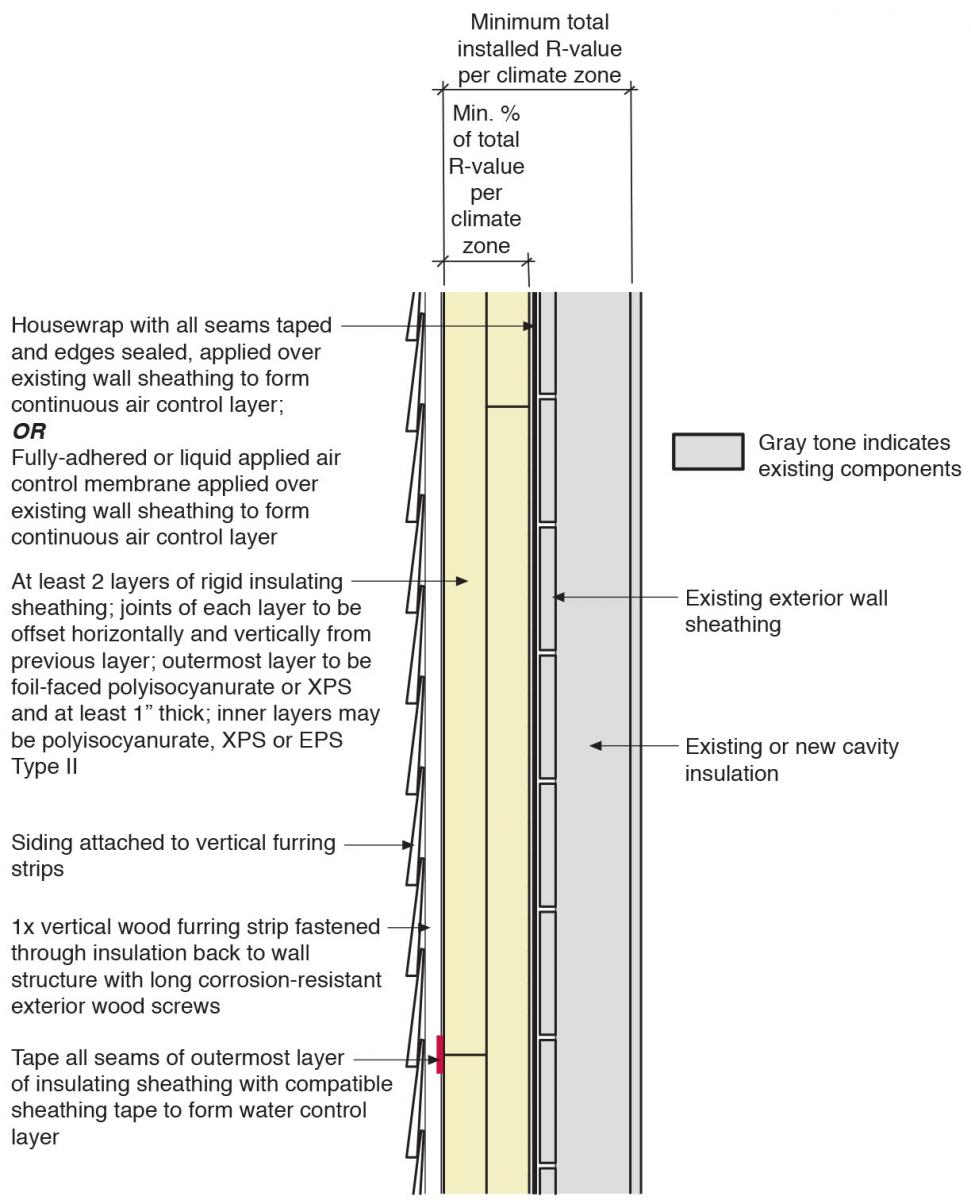
There are two possible locations for the h2o control layer for this retrofit wall assembly – at the outer face of the insulating capsule or betwixt the insulating sheathing and the existing outside wall.
Insulate the walls of an existing home past removing the existing cladding and installing rigid foam insulating sheathing to upgrade the major building enclosure functions of the wall – water control, air command, vapor command, and thermal control, equally follows:
- Remove existing wall cladding and trim.
- Ready the wall sheathing for air/water control membrane.
- Remove windows and doors as needed to allow flashing of openings and air control transitions into openings.
- Install a continuous air/water command layer to the original capsule or to the insulation sheathing.
- Transition the wall air/water command membrane to next assemblies.
- Install flashings and air control transitions.
- Re-install windows and doors or install new windows and doors in properly flashed openings.
- Install insulating sheathing in accord with code to satisfy the high R-value performance target for the associates and for adequate condensation control.
- Install furring strips over insulating sheathing and adhere to structure (structural sheathing and/or framing) through insulating sheathing. Install furring strips in a vertical orientation only.
- Install wall cladding and trim, past attaching to the furring strips.
See the Compliance Tab for related codes and standards requirements, and criteria to meet national programs such as DOE'south Null Energy Set Home program, ENERGY STAR Certified Homes, and EPA Indoor airPLUS.
Description
One method for increasing the insulation level of the walls in existing homes is to remove the exterior cladding and install rigid foam insulation, possibly new business firm wrap, and new outside cladding over the walls. This footstep not merely increases the wall R-value, it can also profoundly improve the performance of the walls to control the move of air, vapor, and h2o through the walls.
Some advantages to this retrofit approach include minimizing the touch on of the wall retrofit on the interior finishes of the existing house, supporting continuity of the water and air command layers, reducing thermal bridging or estrus transfer through wall framing, and lowering the risk of water damage and condensation within the existing wall structure.
In Figures 1 and 2, the wall siding is represented as lap siding, which could be wood, vinyl, or cobweb cement lap siding. Other types of siding that can be attached using the vertical furring strips may exist used too, provided the weight of the siding is less than x lb/sf.
Taped insulating sheathing may serve equally a layer to control h2o, air, and rut loss. However, house wrap or a pigment-on membrane could also be practical to the original sheathing earlier the insulating sheathing is installed.
The insulating sheathing is held in identify by vertical furring strips, forth with other attachments per manufacturer's instructions. The vertical furring strips also provide the means of attachment for the exterior siding and provide a ventilation gap nether the siding.
The house wrap should be overlapped and taped at all seams and attached with fasteners per the manufacturer's instructions. (Run into Figure 2.) If more than one layer of cream is used, the exterior layer of the foam is the h2o control layer and all seams in that layer should be taped with advisable foam-uniform record. The outside cream layer should be foil-faced polyisocyanurate or XPS and the layer should be at least ane inch thick. EPS should not be used as the outer layer but EPS Type 2 could exist used every bit the inner layer. If the exterior of the rigid foam serves every bit the water control layer, the air command layer would still be house wrap or paint-on membrane that is installed between the existing house sheathing and the rigid cream.
The location of the h2o control layer has implications for how the water command function is handled at transitions and interruptions. For example, in window installations, if the water control layer is over the existing sheathing, the windows are installed within the existing wall framing. If the h2o control layer is at the face of the insulating capsule, the windows are installed within the insulating sheathing layer of the wall, in order to integrate the window flashing into the water control layer.
When installing this retrofit wall assembly, it is recommended that multiple layers of insulating sheathing be applied to the exterior of the existing wall. For example, rather than installing one 2-inch layer of rigid foam, two 1-inch layers are installed. This creates a vapor impermeable layer on the exterior of the existing wall. If there is a wetting result (east.chiliad., a plumbing leak) that causes the existing wall structure to become wet, it is important that the wall is able to dry to the inside. To allow drying to the inside, any new or existing awarding of closed-cell spray foam in the wall cavities should be express to a thickness of no more than than one inch. For other types of spray cream insulation, the vapor permeance of the installed thickness must be at to the lowest degree one.0 perm. Open up-cell spray foam insulation meets this criteria for typical framed wall cavity depths. This may non be the case for some medium-density spray foams.
Information technology is advisable to avoid utilize of an interior vapor barrier and vapor impermeable wall coverings such as non-latex paint and vinyl wallpapers with this retrofit wall approach considering these limit the drying potential to the interior. These types of wall coverings may contribute to problems if the interior space has high humidity, at that place is a history of water leakage in the wall, or the outside wall has gotten wet during construction.
How to Install Rigid Foam Board Insulation at Outside Wall
- Remove the existing wall cladding and trim, and inspect the structural integrity of the wall. Check the wall framing for any deficiencies, rot, insect damage, etc. Based on the findings of the inspection, revise the wall associates plans and review specific detailing as needed. Continue only after needed repairs are performed. Meet or exceed the minimum requirements of the electric current adopted building and energy codes.
- Prepare the wall capsule to receive the air/water control membrane or business firm wrap, if ane is going to be used. Advisable preparation of the wall sheathing will depend upon the nature of the existing sheathing and the air command strategy pursued. If using a sheet skilful (business firm wrap) as the air/water control layer, all protruding fasteners must be removed to avert punctures or tears in the membrane. Gaps or voids in the sheathing layer may need to be filled in. Utilize a primer for cocky-adhered membranes if recommended by the membrane manufacturer if installing membrane.
- Remove windows and doors and trim to allow for proper flashing of the window and door openings, and to let the installation of air command transition membranes.
- Install a continuous air control membrane (house wrap or paint-on membrane) over the existing sheathing equally shown in Effigy ane. Connect the air command membrane to the air control layer of adjacent assemblies in a tight and durable way. Seal all penetrations against air and water leaks. This layer may also serve equally the h2o control layer, or the surface of the rigid foam tin can serve every bit the water control layer if all seams are sealed, every bit shown in Effigy 2.
- Install flashings and air control transitions. Transition the air control at the top and bottom margins of the exterior wall into the window and door crude openings and air seal all penetrations through the wall. Flash window and door rough openings as well as all wall penetrations.
- Re-install windows and doors or install new windows and doors in properly flashed openings. If the h2o control layer is over the existing sheathing, the windows are installed inside the existing wall framing whereas if the water command layer is at the face of the insulating sheathing, the windows are installed within the insulating sheathing layer of the wall. This is to ensure the window flashing is properly integrated into the water control layer. Air seal the window and door units to the air control transition membranes at the interior perimeter of the window and door units.
- Install insulating sheathing over the air/water control membrane. Butt joints tight. When installing multiple layers, commencement seams in 2 directions. If the surface of the rigid foam will serve as the water control layer, then the exterior layer of rigid foam cannot be EPS, it must exist foil-faced polyisocyanurate or XPS and all seams of the exterior foam layer must be taped. Until furring strips are installed, insulating sheathing pieces can be held in identify with cap nails or screws with covering washers.
- Install furring strips over insulating capsule and attach furring strips to the wall structure (structural sheathing and/or framing) through the insulating sheathing. Install furring strips in a vertical orientation merely. It is important to install furring strips in a vertical, not horizontal, orientation to allow drainage backside the cladding/trim and to prevent water from dwelling within the organization. 1x4 furring is recommended. The furring need not be preservative treated for wet protection. The spacing of fasteners through the furring strips must exist such that the cladding load is distributed to no more than 10 lb per fastener.
- Attach cladding and trim to the vertical furring strips.
Ensuring Success
Refer to the electric current adopted building and energy codes for information on appropriate levels of insulation for the different climate zones as well as the proper ratios of vapor and air impermeable and permeable insulation.
Remediate any hazardous conditions that will be affected (eastward.thou., exposed or aggravated) by the planned work. Follow applicative laws and industry procedures for mitigation of chancy materials. Engage the services of a qualified professional when needed.
Given the increased airtightness associated with this retrofit, combustion prophylactic testing and controlled mechanical ventilation upgrades are required to maintain acceptable indoor air quality.
Climate
The exterior wall assembly should exist designed for the specific hygrothermal region, pelting exposure zone, and interior climate where the home is located.
The map in Effigy 1 shows the climate zones for states that have adopted energy codes equivalent to the International Energy Conservation Code (IECC) 2009, 12, 15, and 18. The map in Figure two shows the climate zones for states that have adopted energy codes equivalent to the IECC 2021. Climate zone-specific requirements specified in the IECC are shown in the Compliance Tab of this guide.
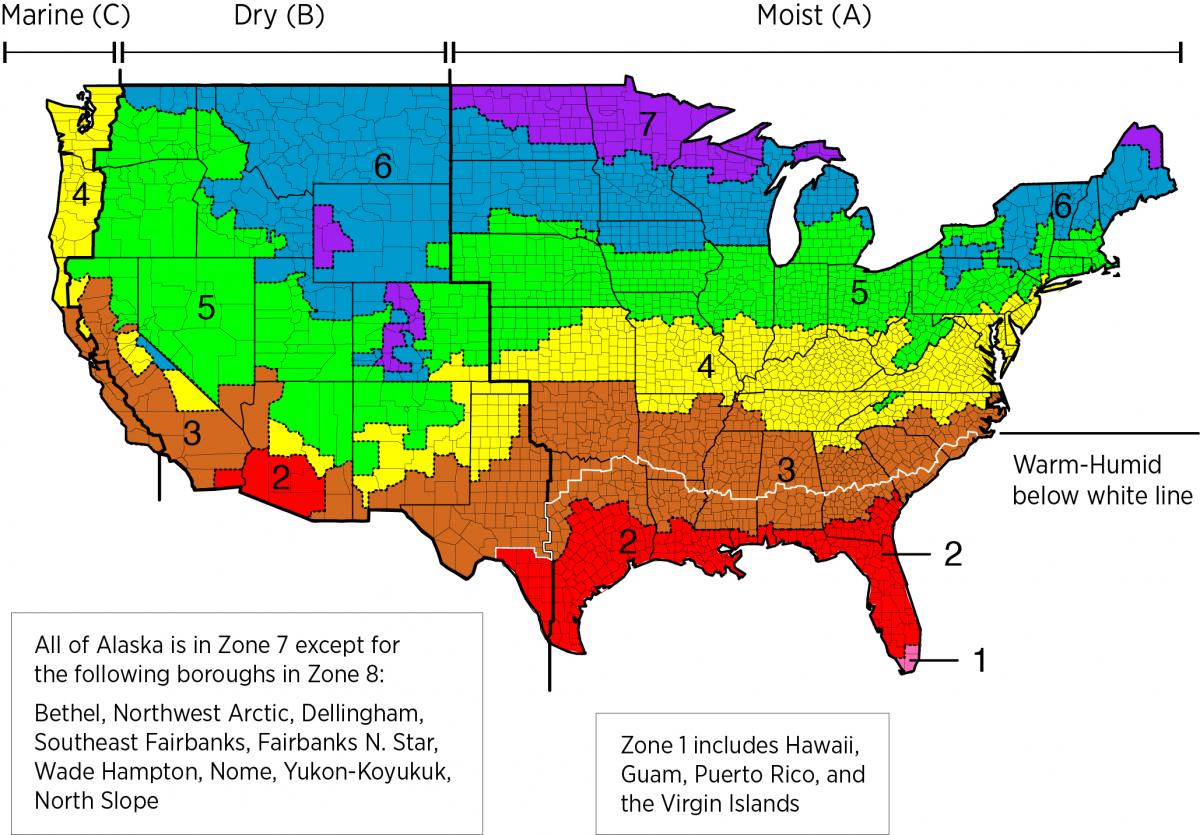
Figure 2. Climate Zone Map from IECC 2009, 12, xv, and 18. (Source: 2012 IECC)
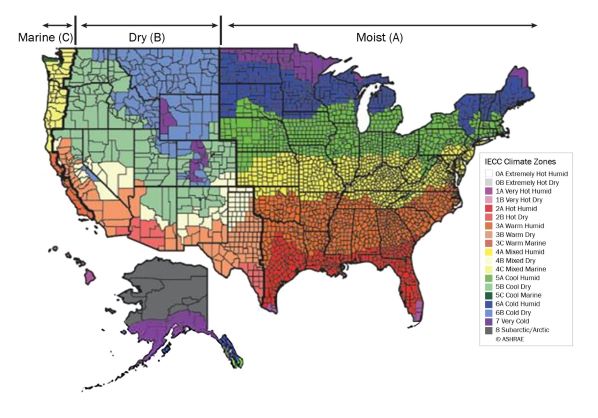
Figure 2. Climate Zone Map from IECC 2021. (Source: 2021 IECC)
Common cold Climates
The insulation levels should be based on the minimum requirements for vapor control in the current adopted building code and the minimum requirements for thermal control in the electric current free energy code. Additional insulation can be added to a higher place these minimums to create high R-Value exterior wall assemblies. The minimum insulation requirements for ceilings, walls, floors, and foundations in new homes, every bit listed in the 2009, 2012, 2015, 2018, and 2021 IECC and IRC, can be found in this table.
Loftier Wind Zones
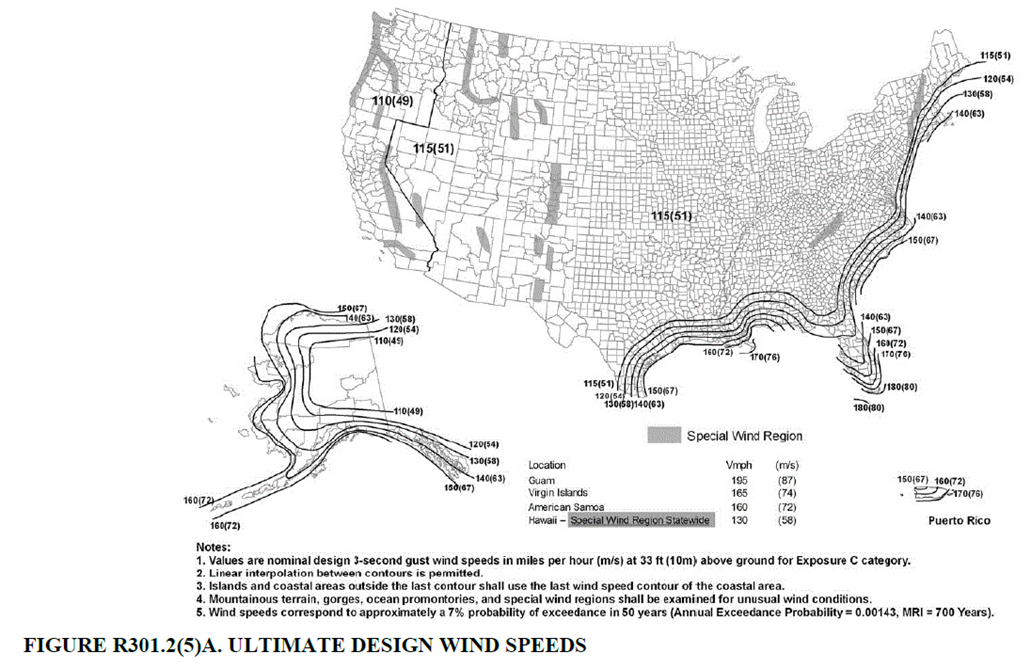
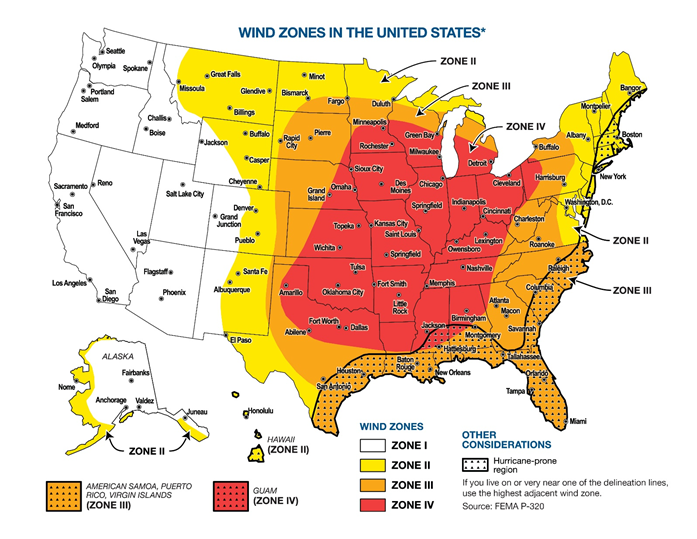
If your home is located in ane of the designated loftier-wind zones shown in Effigy 3 and Figure 4, ensure that siding is wind resistant to minimize the risk of damage to the rigid foam capsule layer.
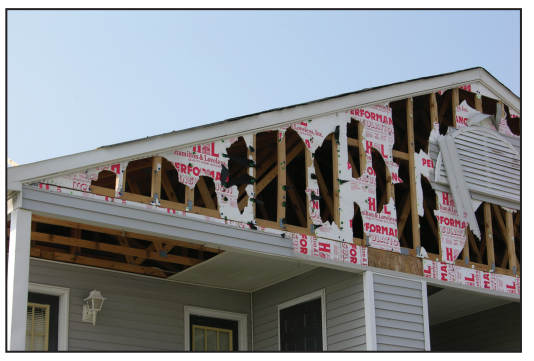
Rigid cream should not exist used as the sole sheathing textile in gable stop walls in high-current of air areas; it should be supported by plywood or OSB. In the business firm shown in Effigy five, the vinyl siding at the gable terminate wall was installed over plastic cream insulation with no plywood or OSB wood sheathing behind it. The foam insulation and vinyl siding alone were not able to withstand current of air pressures which caused the wall to fail allowing current of air-driven rain to freely enter the attic and saturate the ceiling insulation, causing collapse of the ceiling.
Wildfire Prone Areas
With express exceptions, International Building Code Department 2603.five.5, Vertical and lateral fire propagation, requires wall assemblies in Type I, II, Iii and IV construction using cream plastic insulation to pass the National Fire Protection Clan (NFPA) 285 testing requirements. Despite stating "non-load begetting" in its title and scope, NFPA 285 applies to both not-load bearing and load-bearing walls. In that location are many polyiso, EPS, and XPS rigid foam products that have passed the NFPA 285 wall assembly exam for burn resistance; some fireproofing installation details may be required. Consult the manufacturers' instructions (Walls & Ceilings 2017).
Come across the Solution Eye guide "Wind and Disaster Resistant Siding" for more information.
The Compliance tab contains both program and code data. Code linguistic communication is excerpted and summarized below. For verbal lawmaking language, refer to the applicable code, which may require purchase from the publisher. While we continually update our database, links may have inverse since posting. Please contact our webmaster if you find cleaved links.
ENERGY STAR Certified Homes, Version three/three.ane (Rev. 09)
Free energy STAR Certified Homes requires that ceiling, wall, floor, and slab insulation levels come across or exceed those specified in the 2009 International Energy Conservation Code (IECC) with some alternatives and exceptions, and achieve Form ane installation per RESNET Standards (see 2009 and 2012 IECC Code Level Insulation – Free energy STAR Requirements and Insulation Installation (RESNET Class one). If the state or local residential building energy code requires higher insulation levels than those specified in the 2009 IECC, you must encounter or exceed the locally mandated requirements. Some states have adopted the 2012 or 2015 IECC. Visit the U.S. DOE Building Energy Codes Program to encounter what code has been adopted in each state.
Rater Blueprint Review Checklist
3. High-Functioning Insulation.
3.ane Specified ceiling, wall, floor, and slab insulation levels comply with one of the following options:
3.ane.1 Meets or exceeds 2009 IECC levels4, v, half dozenOR;
3.1.two Achieves ≤ 133% of the total UA resulting from the U-factors in 2009 IECC Table 402.1.iii, per guidance in Footnote 4d, AND specified dwelling infiltration does not exceed the post-obit:five, vi
- 3 ACH50 in CZs 1, 2
- 2.five ACH50 in CZs 3, 4
- 2 ACH50 in CZs 5, 6, seven
- 1.v ACH50 in CZ 8
Rater Field Checklist
Thermal Enclosure System
1. High-Functioning Fenestration & Insulation.
1.3 All insulation achieves Grade I install. per ANSI / RESNET / ICC Std. 301. Alternatives in Footnote 4.four, five
Footnote iv) Two alternatives are provided: a) Grade 2 cavity insulation is permitted to be used for assemblies that contain a layer of continuous, air impermeable insulation ≥ R-3 in Climate Zones 1 to 4, ≥ R-5 in Climate Zones 5 to 8; b) Grade Ii batts are permitted to be used in floors if they fill the full depth of the floor crenel, even when compression occurs due to excess insulation, as long every bit the R-value of the batts has been accordingly assessed based on manufacturer guidance and the only defect preventing the insulation from achieving Grade I is the compression caused past the excess insulation.
Foontote 5) Ensure compliance with this requirement using the version of ANSI / RESNET / ICC Std. 301 utilized by RESNET for HERS ratings.
2. Fully-Aligned Air Barriers.6 At each insulated location below, a complete air bulwark is provided that is fully aligned as follows:
Ceilings: At interior or exterior horizontal surface of ceiling insulation in Climate Zones 1-3; at interior horizontal surface of ceiling insulation in Climate Zones 4-8. Also, at outside vertical surface of ceiling insulation in all climate zones (e.g., using a current of air baffle that extends to the full height of the insulation in every bay or a tabbed baffle in each bay with a soffit vent that prevents wind washing in adjacent bays).seven
Walls: At exterior vertical surface of wall insulation in all climate zones; also at interior vertical surface of wall insulation in Climate Zones 4-8.viii
Floors: At exterior vertical surface of floor insulation in all climate zones and, if over unconditioned space, also at interior horizontal surface including supports to ensure alignment. Alternatives in Footnotes 11 & 12.10, 11, 12
ii.7 All other floors adjoining unconditioned space (east.g., rim / band joists at exterior wall or at porch roof)
3. Reduced Thermal Bridging.
3.iv At in a higher place-grade walls separating conditioned from unconditioned infinite, i of the following options used (rim / band joists exempted):16
iii.four.ane Continuous rigid insulation, insulated siding, or combination of the ii is: ≥ R-3 in CZ 1-4; ≥ R-5 in CZ v-8 OR;17, xviii, 19
3.4.2 Structural Insulated Panels OR; Insulated Concrete Forms OR; Double-wall framing OR;17,20
3.four.3 Avant-garde framing, including all of the Items below:21
3.4.3a Corners insulated ≥ R-6 to edge22, AND;
3.iv.3b Headers in a higher place windows & doors insulated ≥ R-3 for 2x4 framing or equivalent crenel width, and ≥ R-5 for all other assemblies (eastward.g., with 2x6 framing)23, AND;
3.four.3c Framing limited at all windows & doors to i pair of male monarch studs, plus one pair of jack studs per window opening to support the header and sill, AND;
three.four.3d Interior / exterior wall intersections insulated to same R-value as remainder of exterior wall,24AND;
3.4.3e Minimum stud spacing of 16 in. o.c. for 2x4 framing in all Climate Zones and, in CZ half-dozen-8, 24 in. o.c. for 2x6 framing.25
4. Air Sealing (Unless otherwise noted below, "sealed" indicates the use of caulk, cream, or equivalent material).
four.1 Ducts, flues, shafts, plumbing, piping, wiring, exhaust fans, & other penetrations to unconditioned infinite sealed, with blocking / flashing as needed.
Footnote half-dozen) For purposes of this Checklist, an air barrier is defined as any durable solid material that blocks air menstruum between conditioned infinite and unconditioned space, including necessary sealing to block excessive air menstruation at edges and seams and adequate back up to resist positive and negative pressures without displacement or damage. EPA recommends, but does not crave, rigid air barriers. Open-cell or closed-cell foam shall accept a finished thickness ≥ 5.five in. or 1.5 in., respectively, to authorize equally an air barrier unless the manufacturer indicates otherwise. If flexible air barriers such as house wrap are used, they shall exist fully sealed at all seams and edges and supported using fasteners with caps or heads ≥ 1 in. diameter unless otherwise indicated past the manufacturer. Flexible air barriers shall not be made of kraft newspaper, paper-based products, or other materials that are easily torn. If polyethylene is used, its thickness shall be ≥ 6 mil.
Footnote 8) All insulated vertical surfaces are considered walls (e.m., above and below grade outside walls, articulatio genus walls) and must encounter the air barrier requirements for walls. The following exceptions apply: air barriers recommended, but not required, in adiabatic walls in multifamily dwellings; and, in Climate Zones 4 through viii, an air bulwark at the interior vertical surface of insulation is recommended but non required in basement walls or crawlspace walls. For the purpose of these exceptions, a basement or crawlspace is a space for which ≥ forty% of the full gross wall surface area is beneath-grade.
Water Management Arrangement Architect Requirements
ii Water-Managed Wall Assembly.
2.1 Flashing at lesser of exterior walls with weep holes included for masonry veneer and cry screed for stucco cladding systems, or equivalent drainage organization.ix
2.two Fully sealed continuous drainage aeroplane behind exterior cladding that laps over flashing in Item two.1 and fully sealed at all penetrations. Additional bail-intermission drainage plane layer provided behind all stucco and non-structural masonry cladding wall assemblies.9, x
two.3 Window and door openings fully flashed.eleven
Footnote 9) These Items non required for existing structural masonry walls (e.g., in a home undergoing a gut rehabilitation). Note this exemption does non extend to existing wall assemblies with masonry veneers.
Footnote x) Any of the post-obit systems may be used: a monolithic weather-resistant barrier (i.due east., house wrap) shingled at horizontal joints and sealed or taped at all joints; weather resistant sheathings (e.g., faced rigid insulation) fully taped at all barrel joints; lapped shingle-style building newspaper or felts; or other h2o-resistive barrier recognized by ICC-ES or other accredited agency.
Footnote xi) Use pan flashing over the crude sill framing, inclusive of the corners of the sill framing; side flashing that extends over pan flashing; and summit flashing that extends over side flashing or equivalent details for structural masonry walls or structural concrete walls.
Please see the ENERGY STAR Certified Homes Implementation Timeline for the program version and revision currently applicable in in your land.
DOE Zero Energy Ready Abode (Revision 07)
The DOE Naught Free energy Ready Home Programme is a voluntary high-performance abode labeling plan for new homes operated by the U.South. Department of Energy. Builders and remodelers who are conducting retrofits are welcome to seek certification for existing homes through this voluntary program.
Showroom 1 Mandatory Requirements.
Exhibit one, Item i) Certified under the ENERGY STAR Qualified Homes Program or the ENERGY STAR Multifamily New Construction Program.
Exhibit 2, Item 2) Ceiling, wall, flooring, and slab insulation shall meet or exceed 2015 IECC levels and attain Grade i installation, per RESNET standards.
2009-2021 IECC and IRC Insulation Requirements Table
The minimum insulation requirements for ceilings, walls, floors, and foundations in new homes, every bit listed in the 2009, 2012, 2015, 2018, and 2021 IECC and IRC, tin be found in this table.
2009, 2012, 2015, 2018, and 2021 International Energy Conservation Code (IECC)
Section R401.3 Certificate
Department R402.ane.2 (402.1.1 in 2012 and 2009 IECC) Insulation and fenestration criteria and requirements past component
Table R402.i.two (402.1.iv in 2009 and 2015 and 402.1.3 in 2009 and 2012 IECC) Equivalent U-factors
Section R402.iv Air leakage (Mandatory)
Tabular array R402.iv.1.ane (402.4.2 in 2009 IECC) Air barrier and insulation installation
Retrofit: 2009, 2012, 2015, 2018, and 2021 IECC
Section R101.4.3 (in 2009 and 2012). Additions, alterations, renovations, or repairs shall arrange to the provisions of this code, without requiring the unaltered portions of the existing building to comply with this lawmaking. (Run into code for boosted requirements and exceptions.)
Chapter 5 (in 2015, 2018, 2020). The provisions of this chapter shall control the alteration, repair, improver, and modify of occupancy of existing buildings and structures.
2012 and 2009 International Residential Lawmaking (IRC)
Section R302.ane Exterior walls
Table R302.1 Exterior walls
Section R302.10 Flame spread alphabetize and smoke developed alphabetize for insulation
Section R316 Foam plastic
Department R403.3.iv Termite damage
Department R703 Outside covering.
Section R703.11.2 Foam plastic sheathing
Section N1101.12.1 (N1101.4 in 2009 IECC) Building thermal envelope insulation
Section N1101.12.4 (N1101.6 in 2009 IECC) Insulation production rating
Section N1101.16 (N1101.9 in 2009 IECC) Certificate (Mandatory)
Section and Table N1102.one.1 (N1102.i in 2009 IECC) Insulation and fenestration criteria and requirements past component
Table N1102.one.1 Insulation and fenestration requirements by component
Table N1102.1.3 (N1102.1.2 in 2009 IECC) Equivalent U-factors
Section N1102.4 Air leakage (Mandatory)
Table N1102.4.1.i (N1102.4.2 in 2009 IECC) Air bulwark and insulation installation/inspection
2015, 2018, and 2021 IRC
Section R302.i Exterior walls
Table R302.1 Exterior walls
Section R302.x Flame spread alphabetize and smoke developed index for insulation
Department R316 Cream plastic
Department R403.3.four Termite protection
Section R703 Exterior roofing.
Section R703.11.2 Foam plastic sheathing (Insulation over foam plastic sheathing in 2018 and 2021 IRC)
Section N1101.10.one (R303.1.i) Building thermal envelope insulation
Section N1101.ten.4 (R303.1.4) Insulation product rating
Department N1101.14 (R401.3) Document (Mandatory)
Section N1102.1.2 (R402.i.ane) Insulation and fenestration criteria
Table N1102.ane.2 (R402.1.1) Insulation and fenestration requirements by component
Table N1102.one.4 (R402.1.iv) Equivalent U-factors (R-value computation in 2018 and 2021 IRC)
Department N1102.4 (R402.4) Air leakage (Mandatory)
Tabular array N1102.4.1.1 (R402.4.1.1) Air bulwark and insulation installation
Retrofit: 2009, 2012, 2015, 2018, and 2021 IRC
Department R102.seven.1 Additions, alterations, or repairs. Additions, alterations, renovations, or repairs shall accommodate to the provisions of this lawmaking, without requiring the unaltered portions of the existing edifice to comply with the requirements of this code, unless otherwise stated. (See code for boosted requirements and exceptions.)
Appendix J regulates the repair, renovation, amending, and reconstruction of existing buildings and is intended to encourage their continued safe use.
Access to some references may crave purchase from the publisher. While we continually update our database, links may have changed since posting. Please contact our webmaster if yous find broken links.
References and Resources*
*For non-dated media, such every bit websites, the date listed is the engagement accessed.
Contributors to this Guide
The post-obit authors and organizations contributed to the content in this Guide.
Mobile Field Kit
The Edifice America Field Kit allows you to save items to your profile for review or utilise on-site.
Sign Up or Log In
Did you observe this data helpful?
Source: https://basc.pnnl.gov/resource-guides/rigid-foam-insulation-existing-exterior-walls
0 Response to "What to Use for Fastening Foam Insulation to Studs"
Postar um comentário